Manufacturing faulty bricks: The Indian Education system

1. The outbreak of the Coronavirus ( politically incorrect?) has severely disrupted and hindered several institutions, including the Indian Education system. Between the increased mortalities by the virus, Indian- Chinese tensions and the breakdown in the economy, the education system is losing the battle of coping with transforming itself in the face of the virus. Come to think of it, educational institutes are supposed to equip kids with the necessary know-how of coping with disaster; the inability of the Indian education system to grapple with the current hurdles is a testament to: those who can’t do, teach.

2. Given the gravity of the situation, you may consider this a little too extreme and inconsiderate; after all, nobody knows the exact coordinates to navigate through these testing waters. And yes, this is not a problem that is localised to India, but is faced by educational authorities across the globe. So, what makes India’s education system an embarrassment to the field of imparting knowledge and encouraging the exploration of human brain? To this end, you will have to understand the kind of system Indian students are expected to learn in. It is against this backdrop, I will then highlight how the pandemic has accelerated the rate of its deteoration.

The compulsive obsession over status, science and routine

3. As a population, like most Asian nations, today, Indians live in a society that functions on the unwritten rule of: the want of status and reputation; and as a parent, you are bound to drag your kid into this. This means that the poor chaps must slog and score more than their classmates, relatives, neighbour’s kid and god-forbid some random child prodigy. Even if it means forcing the kid to forgo of their dreams, ambitions and general sense of direction in life. In a social setting, how the kid does translates into a higher reputation of the parents, because who doesn’t love a kid who is good, well-behaved and follows society’s guidelines? What happened to the pursuit of happiness and knowledge? Where’s the Bruce-Wayne-like curiosity? Who erased the actual meaning of learning?

4. The cause to the above effect is the design of the schooling system. If you are the average Joe that went to a government school for all your life, you’re screwed. This is how the system works: As a student, you have a fixed timetable with fixed exams till the age of 18. Most subjects are mandatory and are taught because they have to be taught and not because teachers want to teach it(unless your teacher is passionate about the subject, and there are a handful of them). For instance, English is taught without the fundamentals of grammar and punctuation (if you notice some severe mistakes in my punctuations, just remember: I was a student of the system). English is not taught to develop a sense of appreciation for literature, language and linguistics. Social Studies is written by the victors and they do a pathetic job. I mean if you are brainwashing the kids, the least you can do is narrate history in a way that is engaging, energetic and convinces children. For most students, learning advanced Science is the default field of study because that’s what their parents want. There is a reason why our country is known for its IT support.

5. For most Indian kids, to live an adult life means to attend a good school, get a degree from a good college, work and get married, have a couple of their own-sub humans. Adding the same kind of  fuel to the same systematic loop for their kids, and thus creating the Indian society.  An Indian kid in their 20s is drawn by the prospect of ‘working’, ‘earning’ and ‘working’. Being adventurous in your 20s, living according to your young spirits and exploring the boundaries of human knowledge is something only kids with open-minded parents do.

6. The underlying principle for this social behaviour can be attributed to the kind of pedagogy that forces you to rote-learn your information, much like that of the Chinese.Growing up,I have been told several times, nobody cares what you write as long as certain key words are included or sentences are present. Although you may have some really good teachers, everybody is forced to forego their definition of learning and follow the syllabus set by the education board so that the kid gets the numbers; because, at the end of the day, the system rewards those who have higher numbers. I forgot to mention that so far, we’ve been operating under the assumption that you are one the kids that not just has access to school, but has access to teachers. Withdrawing this assumption would take you to the state of affairs in most schools in India. A fundamental right in theory, the access to education is not convenient to most people. Not everybody in India can afford to send their kids to study, not everybody thinks that little girls can rule the world someday and even if they do, sometimes the so-called temples of knowledge are so far away that they don’t see the point of education as a long-term investment.

7. Why does all this matter? When you pick up an ice-cream bar only to realise that it is imported from Thailand makes you wonder about the state of human affairs. As a country, can we not make our own Ice-Cream? I do not know the numbers and what they indicate statistically, but if the label of everyday items tell you that it’s not made here—it has to be some sort of an indicator? I mean for god’s sake, how hard is it to manufacture ice-cream?. I mean if the system was designed to teach young kids that dreams and aspirations include making your own stuff, doing your own stuff, and thereby contribute to your society—the world would be a different place. We don’t encourage kids to become teachers, historians or musicians; we don’t remind our kids to recognise and value the history of our nation; and we, certainly do not give the freedom to our kids to teach themselves, discover and explore new paths of living. I have been more than fortunate enough to have one of the most open-minded set of parents I could ask for, but most Indian kids aren’t as lucky. With all this in mind, imagine the impact of the outbreak of the virus on such a system.

THE CENTRAL EDUCATION BOARD AND COVID-19

8. With schools and colleges closed, teaching has gone online. But here’s the thing, not everybody has access to the internet or equipment that supports the internet. The way most Indian students are taught is already a disaster, imagine extending this online. In addition, the trouble is at the most rudimentary level, teachers do not know how to use the tech toys, and the cherry on the icing is that they do not know how to learn to use it, which, brings us back to square one : those who can’t do, teach—and teach incorrectly. For reasons unknown, the government’s solution to addressing the challenges faced by schools is to reduce the syllabus that is taught and not to address the difficulties faced in the ability to access the syllabus. They are trying to solve a problem that does not exist. They are not in-touch with reality and somebody really has to spell it out in a way that they understand. Oh wait! We can’t do that because effective communication wasn’t something we were taught nor learned on our own. No wonder half of the laws of this country are lost in translation.

9. Well then, what should the government do? With one of the youngest population on the planet sitting at home while the world burns, there must be something they can do? Theory within the confines of the classrooms means nothing if the young college kids are crippled by fear and anxiety. Believe it or not, some states were insistent on holding final exams for students despite the outbreak of the virus, and naturally, the students who went to the exam centre, contracted the virus. Apparently, the nothing can stop exams, even if it jeopardises the existence of humanity. Does it really take a pandemic to highlight the deep-rooted flaws in our system? The access to a simple thing like a decent education should not be a luxury despite it being a necessity. The impact of the lack of access to good education is the situation that currently floats. Most Indian kids with an Indian education can resonate with being another brick in the wall of society, except, this wall is tumbling…
The future of online courts in India


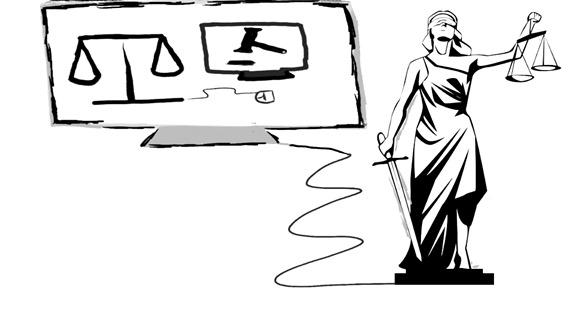
Online Courts picture


In reality, procedure translates the substantive meaning of Justice”

The one thing every lawyer will agree to.

  • It took a pandemic for most of the Indian Judiciary to realise that the internet facilitates the access to Justice. By this I mean that the Judiciary is continuing its operations by holding hearings over video conferencing apps etc.  Despite the security concerns; by continuing to do what they do online, they’ve finally harnessed the utilities offered by the Internet . Such a cool thing. But the aim of this entry is not focused on praising their move to do so, but more pointedly, it’s focused on what happens after things resume to a state of normalcy? What does the Indian Judiciary need to take into consideration while dispensing justice through the Internet.

INVITE INDIA’S FINEST ENGINEERS


  • We’re one of the few countries who manufacture engineers in exponential numbers. Why do we not employ them in ensuring the creation of an accessible system? Although not an exhaustive list, here’s a couple of things I think the engineering communities can help out with:
  1. Installing Computers and Internet: It’s time to rewire the hardware of Court. By this I mean that make computers installed with the necessary word processor should be made mandatory. I can testify to the fact that even today computers and digitalisation are a rarity in the lower judiciary; why? Nobody has a bloody clue. HOW ON GOD’S GREEN EARTH DO WE NOT HAVE BASIC COMPUTERS AND INTERNET? For a profession that emphasis on standardisation and uniformity, we surely perform poorly when it comes to employing the tools that will assist in ensuring it. Sometimes I think they have not upgraded the system as a whole because they want to make sure it’s maintained that way. For heaven’s sake, I think it’s time that we have fibre optics running around in Courts. Justice is only done when things are made accessible!
  2. A functional and compatible website: Here’s another reality check, the websites of our Courts are tedious to understand and requires the skills of a professional navigator. It is not functional in the sense that it is everything but user friendly. As it is people caught in the system have to deal with lengthy procedure of accessing justice; as people who operate the system, the least we can do is ensure that the app or website is user-friendly. Given the grand aura that surrounds the Justice system, the prospect of working with the Indian Judiciary holds a lot more value than you think. This is more than enough to attract India’s youngest and brightest engineers. A Judicial Engineer Intern looks good on paper doesn’t it?
  3. A network exclusive to Judges and Judicial Staff:  Whether you like it or not, being an officer of the Court gives you access to an exclusive network of people and information, which ordinary people do not have. So why not translate this exclusivity by establishing an exclusive network that is solely for the members of this exclusive club I.e. Judges, registrars and other Court Staff. You wanna know the best part of this? You can design and tune the security requirements as per your requirement. And guess what, if you really want to get rid of the non-sense you have to go through the registry, with India’s finest engineers you can create a system of automatic listing on priority basis and not solely depend on people to ensure that your day gets to see the light of the day. Again, this all works out only if you want it to. I hope some higher up in the judiciary ensures a mechanical system in place regarding your case.

THE NEW AGE COURT STAFF


  • Now that you have your basic infrastructure in place, you need to make sure that the machinery is not just functional, but continues to remain so. Just because one knows how to use a smart phone for its basic functions does not mean the user is a born engineer. Registrars and other administrators must take an active initiative in ensuring that everybody involved in Court is acquainted with the mechanics of the digital system. The few years I have spent in the judiciary, the one thing I’ve always heard is that, “ e-filing is just a formality, it does not actually work”. Introducing a system only to realise that is non-operational is utter bullshit. I am surprised that nobody has bought this to the attention of the respective authorities.
  • Training in an accessible language: I’ve tried talking to Court staff in several Courts across our country; the amount they know about tech is appalling. Well, to be honest, I cannot blame them, since it’s not their fault the information they need to know is inaccessible. In other words, information is not available in the regional language they are familiar with. The medium of training the staff must be in the language they understand. For instance, it is pointless to teach your staff in English or Hindi, if their primary mode of communication is in Tamil or Kannada. Unless you are going to standardise the language of communication from the grass root level, you have to teach tech in a language that is familiar to those who are going to be handling it. Failure to do this will not only result into an inefficient system, but will be a futile exercise lost in limbo.
  • A handbook: Try providing an engaging handbook. The purpose of the handbook should be to provide information in an engaging and understandable manner. Bring in the locally popular publishers to help you out with this. The handbook should be written in a manner that trains every staff member to qualify as tech support. By doing this you will equip your loyal staff with skills that will be useful after retirement. Everybody needs some form of tech support.
  • Now that you have your basic infrastructure in place, you need to make sure that the machinery is not just functional, but continues to remain so. Just because one knows how to use a smart phone for its basic functions does not mean the user is a born engineer. Registrars and other administrators must take an active initiative in ensuring that everybody involved in Court is acquainted with the mechanics of the digital system. The few years I have spent in the judiciary, the one thing I’ve always heard is that, “ e-filing is just a formality, it does not actually work”. Introducing a system only to realise that is non-operational is utter bullshit. I am surprised that nobody has bought this to the attention of the respective authorities.
  • Training in an accessible language: I’ve tried talking to Court staff in several Courts across our country; the amount they know about tech is appalling. Well, to be honest, I cannot blame them, since it’s not their fault the information they need to know is inaccessible. In other words, information is not available in the regional language they are familiar with. The medium of training the staff must be in the language they understand. For instance, it is pointless to teach your staff in English or Hindi, if their primary mode of communication is in Tamil or Kannada. Unless you are going to standardise the language of communication from the grass root level, you have to teach tech in a language that is familiar to those who are going to be handling it. Failure to do this will not only result into an inefficient system, but will be a futile exercise lost in limbo.

IMPROVING THE ACCESS TO JUSTICE ONE STEP AT A TIME


  • I find it very cute that our Judicial officers talk about introducing artificial intelligence to improve the management of cases. But none of this smanshy shit works if you do not have your basic hardware configuration working at an optimal level. In other words, your internet, computer systems etch should, at the least be functioning. Although I admire the enthusiasm, I do not think digitisation should be implemented as a one-size-fits-all scheme. You have to tune the implementation of digitising to the state in which you’re trying to introduce this. Failure to consider this and apply a blanket formula of implementation will be futile in the long run.
  • Lastly, here’s an appeal to all those judicial officers, it’s time to widen your networking circles and bring in the young enthusiastic engineering kids who’ll help you out. With the right incentives, you’ll be able to attract the engineers who believe in the cause of Justice and want to transform it.